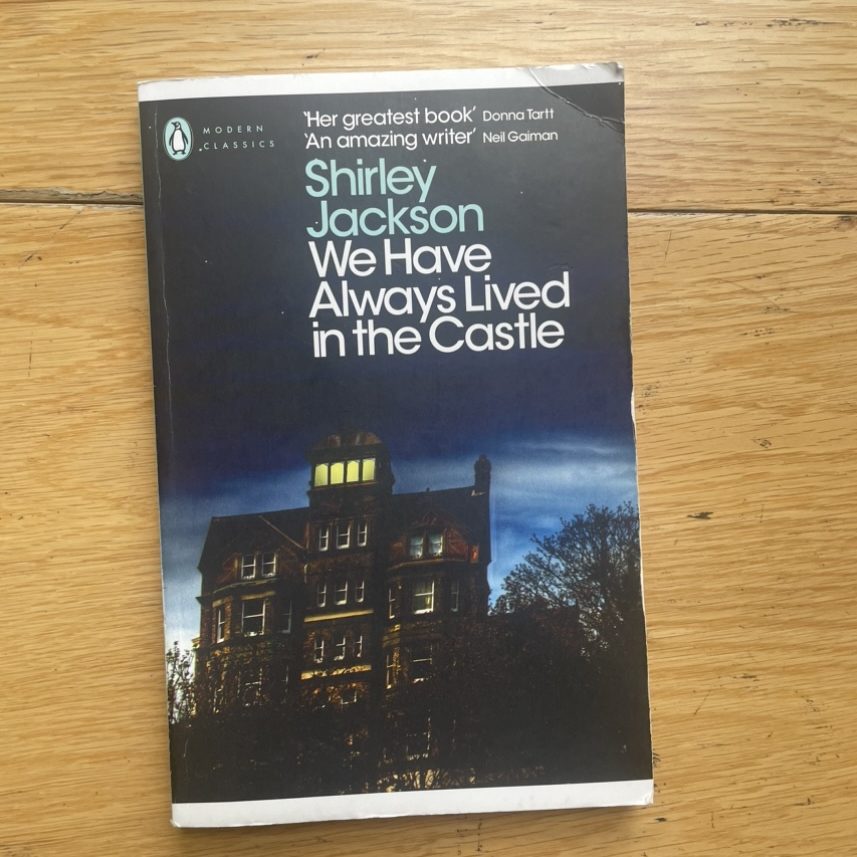
- Buy the book here
- Page Count: 214
- Genre: Gothic, Mystery, Thriller
I’m a massive fan of Shirley Jackson’s work. Her beautiful prose, command of language, and leaning towards oddity and the strange has always been quite favorable to me. We Have Always Lived in the Castle—Jackson’s final published work—is masterfully unsettling gothic fiction, and quite honestly I couldn’t put the book down.
Mary Catharine “Merricat” Blackwood lives an isolated life in a large house with her older sister Constance and their Uncle Julian. Six years prior, Merricat and Constance’s family was poisoned and Constance was accused yet acquitted of committing the murders. The Blackwood family live in isolation, with Constance never leaving the family’s grounds and Uncle Julian bound to the home as a result of his own bout of poisoning that he survived years ago. The village people deeply resent the Blackwood family, and Merricat returns the sentiment and abhors her journeys to the village for groceries. Life falls into a natural, routine seclusion for the three remaining Blackwoods, but all is uprooted when Cousin Charles pays them a visit.
A large focus of this book is otherness and how characters and Merricat and Constance deal with their social ostragization. The women are frequently referred to with near mythical status by the villagers, and there’s a sense of paranormal fear that surrounds their social placement. I thought frequently of the othering of women thgouhought the story. Constance and Merricat are referred to by Cousin Charles to be sort of spinster/old maid figures due to being unmarried, and alludes the holding all of the family money in the house with them as a waste, seeing as in their social positions they do not contribute to the advancement of society.
Merricat’s fascination with magic and warding the home in an effort to protect the family from the outside world is quite fascinating to. There’s an undertone of violence to her narrative voice, yet the story does not demonize her rejection of social placement. In fact, the voice of the village is decentralized, and it’s almost as if we’re following along with the evil witches from the fables and seeing into their lives instead of hearing the tall tales that society tells of them.
My mind repeatedly returned to themes of gender and sexuality while reading this book, and it came natural to consider the story through a lens of queer and feminist literary theory when “otherness” was such a prevailing topic throughout the text. Relationships between women – between the sisters, and between Constance and women from the town – are central to the text. Constance controls the bounds of Merricat’s world and reigns her into this separate society. She embraces the otherness of her sister, allowing Merricat’s eccentricity to take precedence over finance and practicality. With the arrival of Cousin Charles into the text, it’s quite clear how the world of the sisters grifts against common social norms. Readers are invited to embrace the perverseness just as Constance embraces Merricat, and the tables are turned as the town itself becomes the leering figure to hide from.
We Have Always Lived in the Castle is weird and thought-provoking. It’s a masterful text with intriguing characters and many layers to peel away, and it’s one I know I’ll return to as one of my favorite gothic novels.
 Julia's Bookshelves