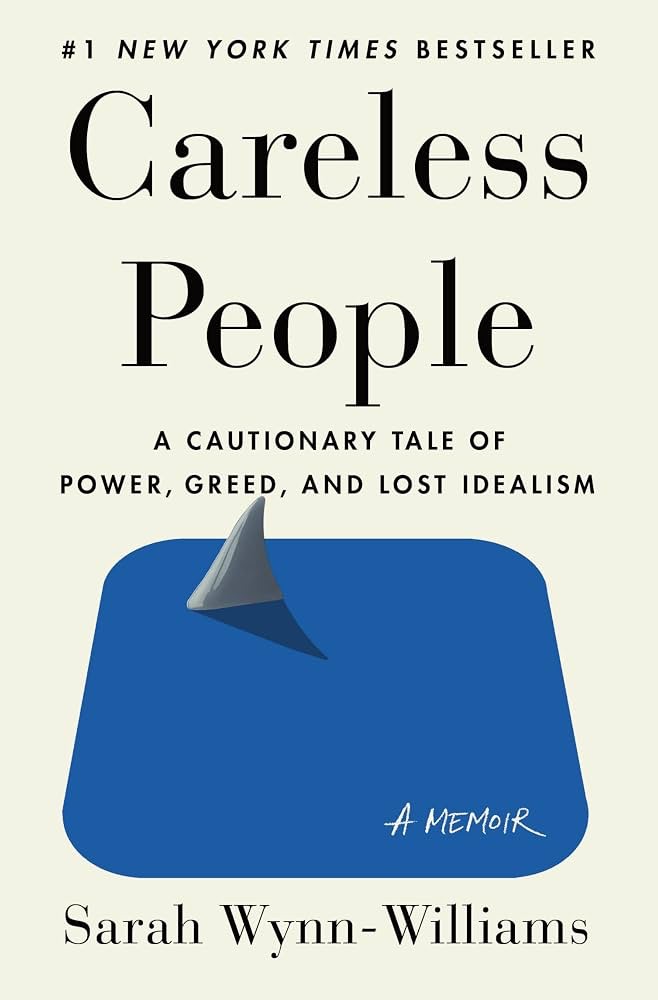
I rounded out September reading with a nonfiction book by former Facebook (Meta) director Sarah Wynn-Williams.
Careless People is a fascinating dive into the world of startup culture and the tenuous relationship between growing tech giants and governments. As we’ve seen, companies like Meta have the power to change elections. From before she was ever hired and Meta, Wynn-Williams saw the power the site could harness and the importance of global government cooperation. The story starts with an uphill battle, where Wynn-Williams fights to foster international relations and convince the executives of the importance of these relationships. As with her own journey with the company, Wynn-Williams begins her story with a more earnest account of the growing company and its founding principles and players. But alongside Meta’s settling permanence in the American zeitgeist, the hunger for more brings tones of darkness and deep social consequences to the story.
I found Sarah Wynn-Williams to be an interesting narrator. On one hand, she’s at the center of it all. From office visits with state heads to globetrotting with Zuckerberg, it’s undeniable that her work greatly uplifted Meta’s global profile. However, I struggled with sections where the author invites the reader to buy into a level of naïveté on the her part that felt too implausible for such an intelligent and capable woman.
Perhaps it’s the Gen-Z in me, but the idea that the author didn’t see the link between issues like rising teen suicide rates and fascist ideologies spreading online and Meta’s unfettered approach to content moderation felt unrealistic. Growing up in an online world means these stats have always seemed so apparent, it’s hard to conceptualize coming from a place where you worked for Meta and still didn’t see the scope of harm in just the last 10 years alone. I spent large swaths of this book thinking how did you not walk away yet?
It’s easier to judge a situation than to live it, but at times I just found myself unable to understand how the author could look such clear harm right in the face and continue to be a willing participant. Of course, this is only one side of the story. So the things that are claimed to have been unknowns to the author can never be fully verified. As with all memoirs, I think it’s important to interrogate just what an author chose to include. And given the public information available of Meta’s impacts on society, equally important to seek out what the author chose to omit.
Plausible deniability or not aside, it’s a genuine reminder that actions have consequences, and silence in the face of ethical ambiguity or downright immoral behavior aligns one with the perpetrator. Do I think you have to agree with a writer’s personal choices to enjoy their memoir? No. And I don’t think Sarah Wynn-Williams seeks to absolve herself of all wronging here, either. The anecdotes are compelling, the prose fast paced, and the story snowballs into a gripping and terrifying cautionary tale.


Thanks. Cricket
LikeLike